
How to deal with challenging behaviour in the classroom: 5 Strategies you can implement now
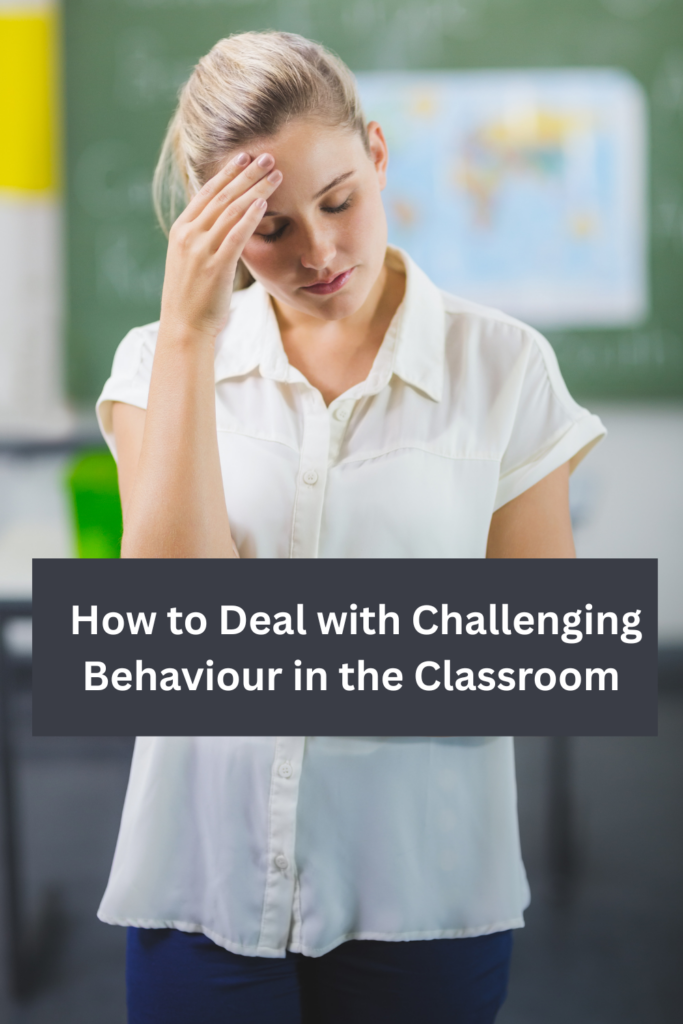
How to deal with challenging behaviour in the classroom is one of the most common questions amongst teachers. Research shows that challenging behaviour in the classroom has reached critical levels and is one of the main reasons teachers are leaving the profession.
It’s exhausting. It’s relentless and can make an already difficult job even harder; especially for new teachers.
How to deal with challenging behaviour in the classroom encompasses some very specific prevention strategies as well as immediate intervention strategies.
This post will give you 5 practical strategies to deal with challenging behaviour in the classroom. It will address both prevention and intervention strategies and give you the tools to control your classroom with confidence.
In This Post You’ll Learn
- Why clear expectations prevent many behaviour issues before they begin
- What to do when students ignore instructions and refuse to comply
- How to address challenging behaviour without escalating the situation
- Practical strategies for regaining control when behaviour starts to escalate
- How to build positive relationships while still maintaining authority
Struggling With a Tricky Class Right Now?
I’ve put together a free guide packed with practical strategies you can implement tomorrow- 5 Quick Ways to Impact a Tricky Class
While many behaviour management strategies apply to both primary and secondary settings this post has greater application within a secondary setting.
Before I get into the first strategy let me give you this reminder- you are the authority in the classroom. You set the tone. You make the rules.
When students constantly misbehave, talk back, take advantage, you can so easily feel overwhelmed, like you’ve lost control. You didn’t spend all those years studying for students to control your lessons. As I said, you make the rules but it’s important you know what rules and expectations you have of students.
One thing teenagers are very good at is looking for loopholes. Loopholes in your expectations and consequences. It’s so important before we get started that you are crystal clear on your expectations and the behaviour system within your school. Once you’re clear on those, these strategies will land so much better.
That leads us nicely into strategy 1
Clear, Consistent Expectations
One of the most effective ways in dealing with challenging behaviour in the classroom is clear consistent expectations. You need to first know your expectations because this becomes your standard, and the standard you hold students to. If you are not clear on what you expect, students will dictate it.
Once you know what your expectations are, be consistent in enforcing them. Let consistency be your reputation.
If you want a deeper dive into consistency read my blog post 5 Game Changing Classroom Behaviour Management Strategies for a Calm Class.
Let’s talk about the start of lessons and your entry routine. Your lessons don’t begin when you start introducing content, it begins when students enter the classroom.
Every lesson I teach with every year group begins in the same way. I stand in the door way and say this as students walk in
“Good Morning Year [X] entering in silence, straight to your seats, the Do Now is on the board.”
My expectation is clear. I want students to walk into my room silently, go straight to their seats and begin working on the starter activity. I later say:
‘Year 10 my expectation is silence, anyone speaking at this point will receive a warning.’
Before students enter the room they know exactly what they need to do and how they need to do it, there is no confusion. My clarity makes non-compliance immediately visible.
Now what do you do when the inevitable happens? Students ignore your instruction and speak, or one student pushes another while walking to their seat.
The important thing to do when challenging or disruptive behaviour arises is address it immediately. Now, there are times when a quiet word or a non-confrontational strategy is required- more on that later.
But, the majority of behaviours need to be addressed immediately, why?
Because what you dismiss becomes the norm.
If a student gives another child a playful push as they enter the classroom and you ignore it, that behaviour is seen as perfectly fine to do again, and it will happen again.
Win the first 5 minutes. When your expectation is not being met, provide a warning or whatever your first level sanction is in your own school.
In some of my challenging classes almost a quarter of the class had a warning within the first 10 minutes of the lesson! I used to think this is just a waste of time- but it isn’t.
If students are unable to follow your instructions, implement your behaviour policy. If a student is making a conscious choice to work against you and disrupt the learning of the class then they need to be removed.
This used to make me feel bad, but I would spend so much energy almost bargaining, giving them chance after chance. It was exhausting, wasted so much lesson time and often made the behaviour worsen.
Get clear on your expectations, state them clearly, and address any students who are not following them.
The Power of a Reset
‘If a class doesn’t enter the room in a way that meets your expectations, take them out and start again.
I remember hearing this in training. It made complete sense in theory but practically it wastes so much time – so I thought.
Let this phrase stick with you:
Time spent on expectations and routines is never wasted.
Yes you may be behind in the curriculum and spending 5 minutes practicing how to enter the classroom feels like a waste- but, this is the very thing that will give you more time back in the long run.
Resetting the class is stopping whatever you are doing and bringing the class back into alignment with your expectations.
It happens all the time you’ve set students off on a task and asked for silence. There’s silence for a few minutes. You go and help a student and the chatter begins. Two students begin dashing paper balls at each other behind your back. Another student looks at their phone under the table.
Within a few minutes the noise level is so loud.
You shh shhh and shhh and students still continue to talk. What do you do now?
Reset. Stop them and start again.
All pens down in 3…. Eyes on me in 2…. Anyone who is still talking at 1 will receive a warning…. And silence in 1. Pause. Wait. Do not speak. Then reiterate your expectations.
Year 10 my expectation was silence. If I am helping someone you are still working in silence. In a second I am going to ask you to continue on with your work. Anyone who speaks will receive a sanction . Writing in 3… 2…. 1… off you go. Stand at the front of your class and scan the room for compliance.
Don’t think you can only reset once. Certain classes may need several resets, that’s fine.
Remember what you dismiss becomes the norm. Do not allow students to blatantly ignore your instructions. Sanction where necessary but also praise those who are following.
Before we get into strategy 3- if you’re dealing with a tricky class right now and need something you can implement tomorrow, grab my free guide : 5 Quick Ways to Impact a Tricky Class.
Avoid the back and forth
You discipline a student. They reply with my favourite
‘But it wasn’t me though.’ As if you are blind.
You reply with a remark to put them in check.
They then reply with something disrespectful and before you know it the situation has escalated to a place you didn’t expect.
It’s a cycle I have found myself in one too many times. And if I’m honest I would willingly enter into this cycle to get the final word.
If there’s one thing I hate more than anything it’s disrespect so when a student was disrespectful I would always ensure I told them what’s what.
But I soon realised that this back and forth dialogue only ever made the situation worse. I’d often make a snarky remark which would get the students back up. To save face they would then respond inappropriately and then the whole thing has moved to a new level.
When challenging behaviour arises try with all your might to avoid entering into a back and forth conversation with a student.
Give your reminder/warning clearly stating the error they have made and what you expect of them. If behaviour still persists, escalate to the next level in your behaviour policy.
Students can often start throwing out statements like
‘I didn’t even do anything, it wasn’t even me’
‘Tell me what I did’
In those cases, clearly state in simple language what the error was
For example ‘ I asked you to turn around and get on with your work and you are still talking, that’s a demerit’
Then move on. If the student continues to engage in conversation shut it down
‘We can talk about this later’
Then carry on with your lesson.
Resist the urge to respond. You’re smarter and wiser. Take the high road- it’s hard, but necessary.
I want to pause here and say this. It is never acceptable for a student to disrespect you in a lesson. If that is happening, it needs to be addressed immediately. That student needs to be removed in my opinion and their behaviour discussed with them at a later date.
It is not always easy, but the key here is this – don’t let behaviour derail your whole lesson. Address it and move on, always escalating when necessary.
Stay Calm and use Calm Minimal Language
Easier said than done. In the midst of a challenging lesson, you’re exhausted, you’re trying to teach and it seems like everything and everyone is working against you.
You are anything but calm.
Teenagers can instantly tell when you’re frazzled – they then feel like they’ve won. When they feel like they’ve won the power then shifts to them.
When a student has thrown something across the classroom, or hurls abuse at another student your immediate reaction is to raise your voice but try to stay calm and composed.
Like you are in control- even when you feel like you aren’t.
Take a deep breath (or several) and try a response like this:
‘Tommy we do not throw things across the classroom, that will be a removal.’ Ok Year 8 let’s all turn to page 10 in 3, 2, 1.’
Responding to Tommy’s actions does not need to take up precious lesson time. His actions do not need a lecture. He did something he wasn’t supposed to do and he most likely knows it. Address the behaviour, sanction it and move on with your lesson.
Don’t match students’ elevated emotional state with a similar elevated emotional state. A calm response almost always disarms.
Give students a face-saving way out
Now this strategy is often forgotten but powerful in how to deal with challenging behaviour in the classroom.
It was Monday afternoon and I was registering my challenging Year 9 class.
One of my students was wearing a scarf indoors. I asked her to remove it. After I’d taken the register I saw she was still wearing the scarf.
‘Can you remove your scarf, I’ve already told you’
‘Why does it matter, how does it affect my learning’
‘Just remove your scarf. That’s a warning’
Ahh I’m doing it man, stop saying the same thing over and over again
Don’t be rude. I’m sorry if you’re having a bad day but don’t take it out on me.’
‘Ohh whatever you keep saying the same thing, just stop.’
Raised voice. ‘That’s a removal’
She then stormed out of the room.
‘Listen Year 9 if you’re upset, sorry, but don’t take it out on everyone else.’
I’ve mentioned this before- I am a stickler for respect, disrespect frustrates me and I always make it a point to explain to students that their mood does not dictate their manners.
But, this situation made me think.
On reflection I was tired, pregnant and just couldn’t be bothered. My fuse was short and I definitely had no patience in this situation.
However this series of events was inevitable.
I gave this student no way out, no way to save face in front of the class. What I said was correct, she shouldn’t take her bad mood out on me. But saying this in front of the class was not necessary at this moment.
She was not usually like this, so something was definitely going on. However, I embarrassed her. Teenagers always want to save face in front of their peers.
Even though her remarks were rude, I backed her into a corner and to get out of the situation her only choice was to storm out.
In the midst of challenging behaviour it’s difficult to think about students’ feelings, but here’s the thing
Behaviour communicates something.
My student was upset about something. Maybe something happened at home, with friends, maybe she was having a bad day- we all do.
I should have walked up to her and privately asked her to remove her scarf again.
Something like
‘ Hey …. Could you please remove your scarf, thanks so much’
And then move on. Eventually she probably would have removed the scarf.
Very often a private word and then a check in later can do wonders.
I know there are several decisions you need to make every day and students should do what they are told.
But, always remember, they are developing human beings, their emotional regulation system isn’t quite developed yet. They are battling hormones and several pressures that we did not face as kids.
Help them make the right choice.
HOW TO DEAL WITH CHALLENGING BEHAVIOUR IN THE CLASSROOM-Bonus Strategies
Restorative Justice Conversations
After a challenging lesson, with several students removed, the last thing you want to do is go and speak to them. You just want to forget about it and them.
However, we cannot ignore the power of connection in behaviour.
One thing that can have a huge impact is a restorative justice conversation.
This is simply finding the student at a later date and having a conversation with the aim of repair and reset.
Ask questions like
‘ Sally, do you understand why I had to remove you today?’
‘ I removed you because….
Add some encouragement
‘I know you are capable of being on task and producing some great work. Let’s have a fresh start next lesson ok?’
Almost always you’ll get an apology from the student.
Yes you have to take the time out and have these conversations but they can do wonders for your next lesson.
PERSONAL Reset
I want to close out this post by saying this.
Challenging behaviour is exhausting and very often we take this home with us. Instead of letting the emotional toil of a bad lesson consume you, practice saying this:
This was a tough one.
It was tough because…..
Next time I’m going to…..
And then leave the emotion behind. Learn from it and move on.
When you get home do something you enjoy.
This post gave you 5 strategies and 2 bonus tools to deal with challenging behaviour in the classroom. It’s not easy but implement these and watch your confidence grow.
If you’re struggling with a tricky class right now and need something you can use tomorrow, grab my free guide:5 Quick Ways to Impact a Tricky Class.
Related Post: 5 Game-Changing Classroom Behaviour Management Strategies For a Calm Class
Related Post: 5 Powerful Ways to Control a Class Without Yelling